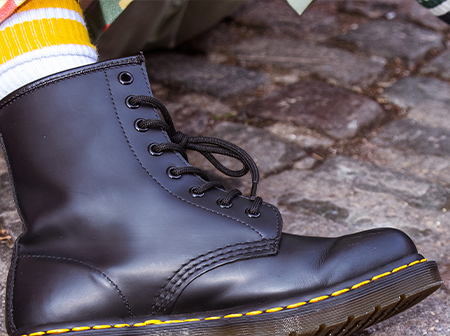
We believe the most responsible thing we can do is to maximise the longevity of each pair through the creation of timeless, hardwearing and repairable footwear.
We’re also adopting more sustainable and traceable materials without compromising on durability.
CIRCULARITY
Dr. Martens footwear is iconic, timeless and durable. We are building on our proud heritage by working to prolong the life of our products and developing responsible end-of-life solutions. We want to support our wearers to keep their boots on their feet for as long as possible through care, repair and resale so we’re working to scale our circularity services globally.
In the UK, we’ve partnered with The Boot Repair Company to offer high-quality authentic repairs. The Goodyear welted construction and heat-sealing process used across most of our footwear means our products can be resoled, allowing us to refurbish them with the same methods and materials used in their original manufacture. Through this service, we breathe new life into old footwear to keep them going for longer. Check out our authorised repair service here.
Resale is the next step forward on our journey to help our wearers make the most of their Dr. Martens products. Our resale channel, ReWair, offers pre-loved Dr. Martens footwear and accessories to consumers in the UK and USA to keep products in use for longer. You can find USA resale here and UK resale here.
Durability and care
One of the most effective ways to reduce the environmental footprint of a product is to prolong its life. Research by Waste and Resources Action Programme (WRAP) has shown that increasing the lifespan of clothing by only nine months could reduce its annual carbon, water and waste footprint by 20–30%.
The timeless design and durable construction of our products mean they stand the test of time when cared for properly - but even tough shoes need looking after. Learn how to maximise their life and care for your boots by following the links below:
COLLABORATION
Even the most loved boots will one day reach the end of their useable life. So we’re also working to develop sustainable end-of-life options, like material segregation and recycling. Transitioning the footwear industry to a circular model is challenging due to the multi-material nature of footwear, alongside limited collection and recycling infrastructure. To help address these barriers, we are contributing to Fashion for Good’s Closing the Footwear Loop initiative, which brings leading brands together to advance circular design, improve post-consumer waste solutions and validate innovative recycling technologies. Through this collaboration, we aim to support the shift toward a more circular footwear industry and help drive systemic change to reduce waste.
Materials
The materials we use not only underpin the durability, look and feel of our footwear, they also influence the lifecycle impacts of our products. We are developing more sustainable materials for the future, such as bio-based alternatives, which supports our commitment for all our footwear to be made from sustainable materials by 2040.
We have developed a framework to ensure materials selected consider all our sustainability requirements, rather than only looking at one aspect. We have called this our DRP Sustainable Materials Criteria, which evaluates if materials are:
- Durable
- Recycled, Renewable and/or Regenerative
- Produced responsibly
These definitions act as the foundation for our efforts as we work towards meeting our sustainable materials targets.
|
DURABLE Durable materials are paramount to ensuring Dr. Martens products reach their maximum useable life. |
Durability is a core design principle for us, ensuring all products are designed and built to maximise the length of time they can be worn. This means materials must meet our quality and performance standards and align to our sustainable design criteria and timeless brand aesthetic. |
|
RECYCLED/ RENEWABLE/ REGENERATIVE Sustainably sourced materials lay the foundations for more sustainable products. |
Materials must be from credible recycled, renewable or regenerative sources. For recycled, this means material created from post-industrial or post-consumer recycled content. We strive to maximise recycled content without compromising durability. For non-recycled content, materials should be sourced from renewable sources that implement regenerative practices wherever possible. |
|
PRODUCED RESPONSIBLY Sustainable materials are manufactured using environmentally and socially sustainable practices. |
All material production must be underpinned by responsible practices, exemplified by our Supplier Code of Conduct, Workplace and Environmental Standards. This includes ensuring:
|
We are already using materials across our product range which meet our sustainability criteria. We aim to only source from Leather Working Group (LWG) certified tanneries, our standard heel loops are made from 100% post-consumer recycled polyester, and high-performance recycled materials are also being incorporated into other componentry like laces and linings. We are also working to develop new materials where suitable ones do not already exist, such as bio-based outsoles.
Click on the + below to find out more about some of the main materials we use.
Leather is a key material for us. To support our ambition to leave things better than we found them, we are focussing on sourcing traceable, deforestation-free leather and exploring regeneratively sourced leather.
We specify all the leathers used in our products from selected tanneries and aim to only work with Leather Working Group (LWG) certified tanneries. It is also important we investigate and invest in leather alternatives, which forms part of our approach to achieving Net-Zero emissions.
We are a member of the Leather Working Group (LWG)
LWG is a not-for-profit multi-stakeholder organisation committed to reducing the environmental impact of leather manufacturing. LWG certified tanneries are audited on their environmental performance and are awarded a rating of Gold, Silver, Bronze or Audited, depending on their performance.
The scope of LWG has broadened over time, reflecting the growing need to strengthen traceability, transparency and environmental and social standards across the leather supply chain. They are focused on improving resource efficiency, reducing waste and emissions, enhancing chemical management, increasing due diligence on deforestation and animal welfare, and ensuring fair working conditions across the leather supply chain. More information about the LWG audit protocol can be found on the LWG website.
The LWG has contributed to greater efficiency across the global leather supply chain, resulting in better environmental performance across the whole industry. This is why we are proud to work with tanneries committed to improving their processes and minimising their impacts. We currently source all our leather from LWG certified tanneries.
Leather traceability
We are working to continually improve the traceability of our materials back through the supply chain. Material traceability means we can be confident the materials we use are not linked to negative environmental, social or animal welfare practices. The complex layers and structure of the leather supply chain, and the nature of the hide as a by-product, means leather traceability is an challenge that required industry-wide collaboration.
We have worked with our tannery partners to map 97% of the leather we source back to the abattoir. The LWG audit also scores tanneries on how much of the leather is traceable through their supply chain and we take this score into account when selecting tannery partners.
Animal Derived Materials Policy
We have an Animal Derived Materials Policy which sets out our full standards regarding animal derived materials. This includes the materials we do not use, like fur, and recognises the five freedoms as a guiding standard for animal welfare. It also specifies that our shoe care products must not be tested on animals.
Today, the majority of our outsoles are made from an alloy of PVC, a durable and commonly used plastic. Granules are melted and moulded into shape to create our famous Dr. Martens air-cushioned sole. Very little waste is produced from the moulding process because the waste PVC material can be recycled back into the production line. The soles of all our Original products are oil and fat resistant, while the air pockets provide comfort and shock absorption.
To attach the sole, a PVC welt is first stitched to the upper of the boot. The welt and sole are welded together at a temperature in excess of 650°C using a hot blade and pressurised rollers that force the parts together. Once cooled, the two components form one piece of PVC and the sole has been attached without the use of adhesives.
As PVC is largely derived from fossil fuels, we are investing in research and development as we aim for all our footwear to be made from sustainable materials by 2040.
We are committed to developing lower-impact alternatives to our materials, like leather and PVC, as we work towards achieving our long-term Net-Zero and sustainable materials commitments.
We have recently launched products made from an innovative material developed to help address leather waste. Named ‘Genix Nappa’, the reclaimed leather material is made from recycled leather offcuts, to form a soft, lightweight material, without compromising on our renowned durability. Approximately 50% of the material is made from recycled pre-consumer leather fibres, with a synthetic textile core and water-based polyurethane (PU) topcoat. It results in an 80% reduction in carbon emissions compared to conventional leather.
We continue to test and develop a range of materials such as bio-based vegan upper alternatives and bio-based PVC. We won’t compromise on our high durability standards so we follow rigorous testing to ensure these alternative materials meet our aesthetic and performance standards and sustainability criteria. Check out our sustainability report to find out the latest updates on our alternative materials development programme.
Packaging
By 2028 we are aiming for 100% of our packaging to be made from recycled or other sustainably sourced materials.
Most of the packaging we use is to protect and transport our products. We are working towards several improvements, such as sourcing more packaging with a sustainable certification (such as FSC), discontinuing non-recyclable items, and increasing the recycled content. Our shoebox is fully recyclable and is made from 100% FSC recycled cardboard.
We have also reduced the fibre content in our standard cardboard shoe box by 25% and reduced the plastic content in our ecommerce shipping bags by approximately 50%, without compromising product protection.